Showing posts with label Fred Thompson. Show all posts

Monday, November 12, 2007

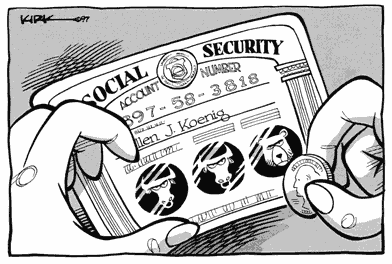
Back Door Privatization Plan


On the one hand...
Like Bush's plan, [Senator Fred] Thompson's would include investments in the stock market. But he said his proposal was different because it would be strictly voluntary and would be added to the Social Security system rather than carved out of it.
Sounds pretty good. You bolster American's savings for retirement, take some of the strain off the trust fund by adding money voluntarily, and even allow people to pick and choose their additional investments.

On the other hand...
Democratic presidential candidate Barack Obama, a senator from Illinois, said Thompson's plan would undermine Social Security and "if we simply ask higher income Americans to contribute a little more, we can shore up Social Security for generations to come."
Social Security contributions cut out at roughly $98,000 of wage and other earned income, but none on other types of income, like rents, royalties, and capital gains and dividends.

Too, Obama misses an obvious point of Thompson's proposal: nowhere in it does he guarantee that this additional investment option would not be phased in to replace the current mandatory taxation plan.

There is a fine balance to be drawn in discussing Social Security, of course: it was never intended to be anything near a primary income source for retirement: instead, it was intended to be a safety net to take the poorest class of citizens in the 30s and 40s, the elderly, the ones most hurt by the Great Depression, and help them survive.

Not survive in style, survive. And considering the average American lived to about 70 (males far shorter), it was not intended as a long-term annuity.

As private pensions blossomed in the 50s and 60s, Social Security was seen as a fill-in to a longer retirement period. As health insurance started to promise longer lived Americans, suddenly Social Security more widely became a necessary stop-gap to pensions with defined benefits for far longer lived Americans (those pension benefits were not always adjusted for inflation).

And so here we are, as the baby boomers officially start to hit benefits drawdown ages.

Is there a crisis, tho? Most estimates show that we can pay out of the trust fund (which are really just IOUs from the Federal government's operating budget) plus current deposits until the 2040s, other things being equal.

Ah, but there's the rub. By law, Federal budgeting cannot assume a worst case scenario when projecting out funds available.

For one thing, the budgeting process has to assume that the US government can pay all its obligations without printing up gobs of money, and driving inflation (and by extension, COLA-adjusted SSI benefits) skyward.

Does anyone here think, with all the meltdowns in mortgage and banking industries, that the Fed isn't about to prop up the current government by lowering interest rates further, driving the dollar even further down on world markets and raising the prices of just about everything?

Second, the projections assume a growing, thriving economy, usually about 2-3% real growth. See the last paragraph. We're careening towards not just recession, but a depression, at least in the consumer arena if not the entire economy, despite what numbnuts like Bernanke say. Fuel prices have jumped 20% since last year, despite inflation's nominal increases. Food prices have jumped on the order of 5% in total, but note that staples have jumped even higher as corn, corn syrup and some other grains are swapped into biofuel projects.

Yuck! And it's not going to get better in 2008 OR 2009, I think.

So while the immediate problems of Social Security are nominal, all this occurs against a backdrop that could show a long-term handcuffing of the income elements and a freeing-up of the factors that will explode disbursements made from the trust fund.

In short, there's a very real chance that the SSI fund will be bankrupt in very short order, while you and I are drawing down benefits.

Neither Thompson's nor Obama's solutions, prima facie, provide enough relief, particularly given the little back door that Thompson left for a shift of the entire program to a voluntary system. We need to radically rethink the entire system, in my opinion, and further, a combination of both of these proposals is a good place to start.

A national dialogue on just what Social Security is and what it should be is the first step off these proposals.

Monday, October 22, 2007

The Hannah Montanans


There's this kiddie trope going around (you'll know this is if you parent a "tween" adolescent): a television program called "Hannah Montana" on the Disney channel.(WARNING: TREACLY TEEN POP IS PLAYED LOUD AT THAT LINK!)

The series focuses on Miley Stewart (played by Miley Cyrus, daughter of regrettable country music "star" Billy Ray "Mullethead" Cyrus), who lives a double life as an average teenage girl at school during the day and a famous pop singer, Hannah Montana, at night, concealing her real identity from the public other than her close friends and family.

Republicans, always seizing on the latest marketing gimmick that Madison Avenue and Hollywood (liberals!!) can develop, have adapted this to their own Presidential race.

Comes last night's debate:
ORLANDO, Florida (Reuters) - The top Republican White House contenders battled on Sunday over who was the better conservative, with Rudy Giuliani and Mitt Romney defending their records and views on social issues from strong attacks.

In a debate in the election swing state of Florida, former Tennessee Sen. Fred Thompson accused Giuliani of being out of step with the conservative values of the Republican Party and Arizona Sen. John McCain attacked Romney's conservative credentials.

"Governor Romney, you've been spending the last year trying to fool people about your record. I don't want you to start fooling them about mine," McCain said. "I stand on my record of a conservative."

Thompson, a latecomer to the race who is chasing Giuliani in national opinion polls, said the former New York mayor's support for abortion rights and gun control put him in a league with Democratic front-runner Hillary Clinton, a New York senator.

"I simply disagree with him on those issues, and he sides with Hillary Clinton on each of those issues I just mentioned," he said.
Thompson, of course, is the ultimate GOP-Hollywood nexus, outdoing even Ronald "I missed World War II to make forgettable B movies in liberal Hollywood" Reagan with such classic conservative roles as DA Arthur Branch (Law & Order), Rear Admiral Joshua Painter (The Hunt For Red October), and Knox Pooley, the neo-Nazi Jew-killer in Wiseguy.

Oh, and we should probably mention the role most dear to the hearts of Republicans and conservative Christians everywhere, lobbyist for a pro-choice group.

Dude, you really can't make this stuff up!

So between Rudy and Romney's former liberal positions (can you say "flip flop"?), Fred Thompson's questionable commitment to Christian values, and John McCain's "Now you see it, now you don't" position on campaign finance reform or Baghdad's safety, we're looking at men who have, to put it mildly, ambiguous moral compasses.

Which brings us back to the Hannah Montana thing: it's OK, I guess, for Disney to show a girl who's so terrified of who she is that she has to hide herself from the world (metaphor: she's a lesbian), but the Republican party?

What I find so funny about all this is any one of the four men could easily have "outted" themselves, "outted" their pasts, and probably not lost a whole lot of standing in the Republican community (and indeed, might have attracted normally uninvolved voters frustrated with the whole Bush administration/christofascist regime thing), but chose instead to narrow their base to the tiniest sliver of scraps on the floor.

Contrast that with the Democratic primary where, for the most part, the candidates have been pretty forthright about who they are, and not running from their history (save Hillary and to a degree, Obama and Edwards regarding their positions on the Iraq invasion...in some ways, I'm not convinced that Iraq won't be the third rail of the 2008 elections the way Social Security reform has long been that same electrified iron).

I don't think it's any secret why the Republican primary, which should be generating enormous interest for a party that's controlled all three branches of government for the past eight years or so, is so bloody boring: no one is willing to take a stance, to chance a roll of the dice and speak what is on his mind.

Without attacking Hillary. That would probably be an added bonus.

It's almost as if these guys are positioning themselves for the 2012 race, when they stand a chance after four years of Hillary-dom, should she screw it up.

Which I wouldn't bet on.

McCain and Thompson all but have to win in this go-round. They'd be too old in 2012 (if indeed they aren't already). Too, Giuliani has to win in this go-round because "9/11 Tourette's" (h/t Jon Stewart) only gets you so far and he's milked that cow.

Leaving Romney, but even he has a shelf life: how much money can he afford to lend his campaign in 2012 if he has to eat tens of millions of dollars this time around?

No, I think this is the only shot for all four of the front runners and I think they've all realized they're going to be sacrificial lambs.

UPDATE: More evidence the GOP may have jumped the couch in this election cycle.

Tuesday, September 04, 2007

Turning Up The Flames


It's the end of summer, Labor Day in the year before the Presidential election, and that means the campaigns kick off in earnest.

Many questions remain unanswered: Can Hillary hold on to a lead that appears insurmountable nationwide, yet is so slim (or worse) in key early states that she could be knocked out by early March? Can John finally get some media recognition (it might have helped if you and Elizabeth hadn't been so ham-fisted early on, John)? Can Barack finally put away the question "Is he black enough?"

And finally...can Fred run?

The GOP race is far more interesting than the Democratic race at this point, in my opinion. The Democrats know the players, and since a late entrance by Al Gore is nearly impossible at this point, we can pretty much sit back and let them hammer out policy positions (although there is an interesting wrinkle ahead for Barack Obama...and a mystery to be solved.)

The GOP, though...with McCain falling out of the race (perhaps as early as next month), the front runners are two RINOs who are desperately trying to shore up the right wing vote without actually taking stands on any issues of substance, like Iraq. As the field stands right now, many conservatives would rather stay home on primary day than vote for either Giuliani or Romney.

Ah....but then there's Fred Thompson. The Economist has an interesting article which points out his strengths and flaws:
Some criticisms of Mr Thompson seem well-founded. He has been running a campaign in all but name—which is illegal, since campaigns require adherence to federal rules, like financial disclosure. This was tolerated, for a while, especially by Republicans who didn’t want to look peevish by attacking him over a technicality. But a Democratic activist has given the proto-candidate a shove by filing a complaint, which Mr Thompson has several weeks to answer. He will almost certainly have entered the race formally by then.

The pseudo-campaign has also been chaotic, with a heavy turnover of staff and rumours of mismanagement by Mr Thompson’s wife. Political junkies who follow the inside business of politics saw a boss too distracted or lazy to bring order to his team. Accusations of a shoddy work ethic in his senate days (1995-2003) also resurfaced.

But Mr Thompson has begun to answer these criticisms. He claimed recently that he was merely waiting until the traditional coming-out period for politicians. And he points to the polls—usually showing him in second place on the Republican side, behind Mr Giuliani—as evidence that he is doing pretty well among ordinary people whatever the campaign experts think. Some see a potential “rope-a-dope” strategy, in which Mr Thompson leans back while his rivals punch themselves out.

Indeed one rival, Mr McCain, has flagged so heavily in recent months—both in campaign finance and in the polls—that many have predicted his exit from the campaign. It would take a minor miracle for him to recover. And this is good news for Mr Thompson: he would then face a pro-choice, gay-friendly New Yorker, and a Mormon from Massachusetts who recently converted to social conservatism, in Messrs Giuliani and Romney.

Mr Thompson has already taken a potshot at the frontrunner on his website, on a highly emotive issue for conservatives—Mr Giuliani’s record of tight gun-control in New York. Next to the former mayor, the gravely-voiced and towering Mr Thompson seems like he could have been born with a shotgun in his hands. Mr Giuliani’s former friendliness to immigrants will also prove a difficulty for him, and an opportunity for Mr Thompson.
In other words, Thompson will out-redneck Rudy and Romney as a strategy to win the nomination, a tough path considering his own checkered stances on issues like abortion while a Washington lobbyist.

Not that consistency is a hallmark of Republican presidential candidates. Remember, George "Yale" Bush ran as a Texas rancher only a year after buying his pseudospread at Crawford.

Too, his mindless disinterest in all things administrative smacks of more of Bush than a real change in the DC dynamic. It was one thing when Reagan followed one of the wonkier Presidents in American history, Jimmy Carter. People got tired of being preached to, and one suspects, turned to Reagan if for no other reason than he seemed to think things would fix themselves (they practically did, one might add).

Right now, after seven (and soon, eight) years of utter lack of interest in anything but a narrow-minded focus on helping his corporate cronies to a larger share of a "higher pie," it seems pretty clear that independents and even moderately conservative Americans see the cries for help of the nation, and realize that they need someone to get his hands dirty.

Or her's.

This is reflected consistently in polls that show all of the front-running Democrats whip Thompson handily in a general election, ties Joe Biden, barely beats Bill Richardson. In fact, the only candidate Thompson can reliably beat is Dennis Kucinich.

For his part, Thompson will have some catching up to do, not much, but enough that he'll have to take some chunks out of Rudy and Romney in order to win some of the early primaries (particularly Iowa and New Hampshire, where Romney has done yeoman work to position himself). That means the "nasty guns" have to be fired.

We ought to be licking our lips that Thompson is finally going to get off the pot Thursday. Imagine, a thoroughly beatable candidate who's going to do our dirty work for us. Remarkable!

Monday, May 14, 2007

I Promise, The Last Rudy Post For A While...

After all the hoopla surrounding the March 31 fundraising reports for the first quarter of 2007, comes this little notice:
WASHINGTON -- Rudolph Giuliani has so far signed up only about a quarter of the major Republican donors he set out last November to enlist as fundraisers for his presidential campaign, records show.

Giuliani's failure to recruit most of those on this early "wish list" is revealed by his early presidential campaign-strategy documents leaked in January.

That anemic track record serves as another indication that key conservatives aren't yet sold on Giuliani, experts say, a problem that could become exacerbated by his recent decision to acknowledge his support for abortion rights.
The news could be worse: he corralled 24 of the 89 he acknowledged he needed, but lost only 21 to either Mitt Romney or John McCain, meaning 44 others, about half, have refused to publicly commit to any candidate.

This is not small potatoes money: these are donors who can reliably raise some $200,000 minimum each for any particular candidate they choose to lavish their attention on. It's still early in the campaign, but the campaign itself has been an anomaly in how early it has turned into a full-bore run for the tape.

Sorry. I've been promising myself I wouldn't report the race like it was a horse race and run poll after poll past you. I had a brain cramp here.

The trouble Giuliani had all along, and really should have acknowledged before setting such a far-fetched goal of obtaining the "89", is that apart from his public persona during the aftermath of 9/11, no one really knew him or understood who he was and what he stood for.

People who are going to pony up in excess of $10 million dollars in toto are going to want assurances that their voices will be heard in the White House, so at the very least, you have to pay a little lip service to tax cut, pro-life, and "American values" positions, none of which Rudy has a particularly strong record on.

That these heavyweight donors stood off to the side while waiting for him to flesh out his stances is not surprising. I should expect that by June 30th, many more will have committed. I'm betting that another half, say 22, will commit but will be split pretty evenly amongst the three top candidates.

There's something at stake for the donors, as well: back the wrong horse, and you have to work twice as hard to curry favor with the winner, and get your voice heard.

There's a cottage industry in "access", sadly it's determined not by need but by resources.

The person who stands to lose the most the quicker more donors jump in is, of course, the candidate who isn't even in the game yet, but I believe that ultimately, the field of candidates from both parties that we see will not generate both party Presidential candidates (save possibly for Hillary, should she survive the primary season, something that's more likely as California, New York, and New Jersey accelerate their primaries).

Who this really hurts is someone like Fred Thompson, who will have to either somehow make enemies all over the party to grab some of these donors, or will have to make do with "populist" fund raising tactics, like Barack Obama or Howard Dean did, but that will also mean staking out some pretty shaky positions slightly away from the inevitable party platform of pro-life, pro-war, pro-Bush.

Saturday, March 31, 2007

Why You Should Care About Subprime Loans

You've read a lot about the sub-prime mortgage market lately and how people from Ben Bernanke to the average shmoe with a few bucks stashed away in his 401(k) are worried, but all you've heard is a lot of reassuring talk amidst the smoke from a distant fire.

There's a reason the Fed chairman has had to reassure the public, twice now: he's protecting his cronies:
In good times, unsustainable loans still turned a profit; the lenders reaped short-term fees and quickly sold the loans to investment banks which chopped them up, repackaged them, and flipped the debt to hedge funds and institutional investors. Now the gravy-train is derailing, and as CFR’s Sebastian Mallaby argues in the Washington Post the investment banks could be exposed as the real scoundrels of the subprime blowup. The banking giants “bamboozled ratings agencies into assigning misleadingly high credit scores to some mortgage-backed bonds,” Mallaby says. This enabled them to pawn off bad debt, disguised as good debt, to unwitting investors.

How far will the damage extend? Bloomberg, in the article cited above, says subprime housing-loan woes could spill over into the auto-loan industry, where highly speculative loans are also prevalent. The issue has global ramifications as well: In late February, subprime concerns sent stock markets tumbling on fears of a U.S. economic slowdown. Even though subprime loans aren’t nearly as common internationally as they are in America, a U.S. credit crunch could still suck liquidity out of global financial markets. Testifying before Congress on March 28, the U.S. Federal Reserve Chairman Ben Bernanke said the subprime issue thus far has had only minimal effects on the broader U.S. economy. But some factors remain unknown. Perhaps the most frightening question is what happened to all that bad debt the investment banks pawned off. Hedge funds, the Financial Times’ Gillian Tett points out, are often masters at using tricky paperwork to cover up their losses. But somewhere, somebody is taking a heavy hit right now. Tett wonders: “Where are the bodies buried?”
The bodies, indeed.

As always in American history, there are parallels to be compared. In this instance, in our own lifetime, we have just such a parallel: the 1989 junk bond bust. Created by the Reagan administration tax cuts, which accelerated depreciation on assets purchased, and exacerbated by President Jimmy Carter's relaxation of regulations on the banking industry (Regulation Q), junk bonds became ubiquitous in the 1980s, through the efforts of investment bankers like Michael Milken, as a financing mechanism in mergers and acquisitions. In a leveraged buyout (LBO) an acquirer would issue junk bonds to help pay for an acquisition and then use the target's cash flow to help pay the debt over time. Basically, it became cost effective to borrow large sums of money at high interest, purchase the stock of a company, take it private, gut it, and all the while, make money (on a tax and cash basis) for the investors.

While screwing everyone else. Eventually this house of cards had to crumble.

Likewise with the sub-prime debacle, as the CFR article notes, enormous sums of money were made in a grand game of hot potato, where the loser is the one holding all the default mortgages at the end.

Namely, the US taxpayer. Remember, Republicans like to privatize profit while socializing losses. We will end up paying for this, just like we ended up paying for the savings and loan crisis (which was an ancillary impact of the junk bond market collapse). A good blogger would point out that a certain former Senator from Tenessee and former TV star with presidential aspirations worked as a lobbyist for the S&L industry. Didn't you, Senator Thompson?

That one was cheap: only $106 billion

There is $7 trillion in mortgages out there. Most of that is safe. But if even $1 trillion (not an unlikely number, since this crisis now spans some six years of mortgage lending before anyone took note and the annual mortgage market in the US is north of a trillion dollars a year, including refinancings and second mortgages), if even $1 trillion is at risk, that could create an economic collapse that would make the Great Depression look like a day at the beach.