Showing posts with label New York Mets. Show all posts

Saturday, September 27, 2008

Goodbye, Old Friend


Eulogies are hard to write. I know, that sounds like a whine.

Saying goodbye is hard. Saying goodbye to someone or something you've known all your life is harder, but I suppose we all must do it.

I grew up a Mets fan, which by definition means I grew up enjoying losing. From the lovable laughable team of Casey Stengel to the current crop of underachieving fuckheads (Scott Schoenweiss Schoe-n-tell is forever etched in my memory as the second worst reliever the Mets have ever had, second only to Doug Sisk Risk), a Mets fan learns to live with losing.

We also learn to live outside the spotlight, in the shadow of the bigger older brother across the Hellgate, the Yankees.

And so here we come to the nub of Shea Stadium. Mets fans love Shea, precisely because like us, it sits in the shadows of its older bigger famous sibling, Yankee Stadium.

Shea Stadium is the city. Yankee Stadium is a suburb. Shea Stadium sits across a small channel from the second busiest airport in the region, LaGuardia. Yankee Stadium rises up out of a park. At Shea, the smell of decaying fish and seaweed drifts and hangs over a game like a shroud. At Yankee Stadium, you might get a whiff of a nearby apartment building's cooking.

Shea sits amidst junkyards and hubcap dealers. Yankee Stadium sits amongst people, but somehow seems disconnected from them, like the dandy who brings his Bugatti to the local gas station because it broke down there on 161st Street.

Shea is of the people. Yankee Stadium is near the people.

Shea is undoubtedly one of the ugliest stadiums ever built. Conceived for two sports, designed for neither, and hurriedly built to open in time with the 1964 World's Fair, Shea exuded the early Sixties optimism for technology and minimalist architecture: get it up and get it built.

My dad was on the project that tore down the old Polo Grounds, the Mets first home. I remember walking that field as a young boy: it was cavernous and loud and echoed with the ghosts of crowds past, who watched the New York Giants play there, and Willie Mays and Ralph Branca.

I've had many opportunities to be on the field at Shea, both as a would-be player scouted for the organization, as a competitive athlete whose races often ended at home plate, and as a fan. It was always, always quiet in those dank mornings by the bay, as if God himself napped in the loge level.

And yet, so many of my memories these past 44 years have been loud ones. I even live-blogged a game in 2006 (sadly, the audio is a dead link) when the Mets captured the Eastern Division title, one of the few years where they achieved something, where they truly were contenders. I remember sitting for The Police concert in 1983, and watching the entire stadium bounce up and down as ninety thousand people stood and danced during "Don't Stand So Close To Me".

Like any good friend, I've seen Shea at her best and her worst. I've sat everywhere in the stadium, from the far reaches of the upper deck to the cushioned comfortable corporate seats just behind home plate at field level, and everywhere in between, including the press level. I've been to miserable Jets games there, when it was cold and rainy and windy...oh, the wind off Flushing bay! There is no wind that cuts you quite as deeply, since no other wind can combine with watching Pat Leahy miss three field goals or Sid Fernandez blow out his knee and the Mets get knocked out of the pennant race in May.

I've been to bright sunny games where the Mets lost by ten runs or were no-hit, but who cared? It was Shea, there was beer (or soda) and friends, and we just sat back and made fun of them.

Today, it is rainy and muggy and gray. Today, I go to wake my old friend ahead of tomorrow's funeral. A particular pall looms over the game today, as the Mets all but played themselves out of contention last night. The Mets will do that to you.

No matter. I go. I will wrap my arms around as much of the stadium as I can, and kiss her and say goodbye. And probably cry a little, just as I am now.

See, it's not a monument to urgency, or a house for a second class ballclub, or a buttugly-piece-of-barely-functioning arena.

It is my childhood. It is my life marching down the path in the woods that I have chosen. I mourn the path least taken, the one I should have, could have, been on.

It is my innocence. It is school day field trips to watch Bob Moose no-hit the Mets. It is the memory of watching John Milner, Rusty Staub and Wayne Garrett crank out home runs in a game in 1973 when the Mets made the most historic climb in history, from fourteen games out in last place to the top of the division in a month and a half. It is the memory of my unborn daughter kicking to root for Gary Carter trying once more for home run 300. It is sitting in the miserable cold October rain as Keith Hernandez pulls his hamstring trying to go first to third when the Mets desperately needed a run in a championship series against the Dodgers. It is Steve Trachsel bringing long-delayed relief to beleaguered Mets fans in 2006. It is heartache and it is unbridled joy and it is, simply, what love is.

It is a book and it is closing now. Goodbye, old friend!

Friday, September 28, 2007

Let's Go Mets!


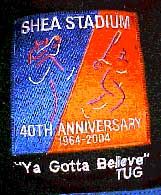
YA GOTTA BELIEVE!

Guys, ya gotta believe that Tug McGraw is looking down from high holy heaven and while he may have won one world championship with the Phillies, he knows, he knows, he's a Met, through and through. Remember, he was in TWO World Series with you.

And he's grinning that idiotic grin of his. This is precisely the kind of situation he would have loved.

Ya gotta believe, you're going to win this thing, that it's out of your hands and your bats and that fate has given you an opportunity to pull this out of the fire. You've set a record for despair now, but it has been at times like this that the Mets have always prevailed. Give a Mets team a chance at the brass ring, and they'll grab it and hold on tight.

1969. 1973. Game six in 1986, of both the playoffs AND the series.

Ya. Just. Gotta. Believe!

We do.

Thursday, February 08, 2007

Major League Gentrification

Like all cities, New York has its ebbs and flows of people moving in and people moving out, and the city does a fairly good job adapting to the tides of both people and the economy. The city was a massive manufacturing hub for much of its incorporated history, and when those jobs faded away, melting to the south and then overseas, New York found a way to adapt (admittedly with some pain). The last bastion of manufacturing in the city, the Garment District, is slowly evolving into a high tech corridor as more garment shops close up.

When I was a kid, I could walk from my parents' apartment on the Upper East Side to a lumberyard (dad was a carpenter...go on, make the most of that!), a junkyard, several car dealerships, four gas stations, and three hardware stores. That neighborhood, almost exclusively working class, is gone practically, replaced by a jet-setting wealth beyond description. The humble little apartment that my mom and dad rent for under $500 is going at market for over $3,000, and that's in a crappy little walk-up.

For decades, it seemed as though the outer boroughs were immune to this gentrification, but I guess it was only a matter of time. Hold-out neighborhoods in Manhattan-- Harlem, the Lower East Side, Hell's Kitchen-- were a bulwark for working class residents, a place they could live where they could work within a short bus or subway ride of home.

About a decade ago, due in some part to the anti-crime efforts of the police commissioners under Rudy Giuliani and giving credit and high marks to both David Dinkins and President Clinton for proposing "Safe Streets, Safe City" and for fully funding it, these parts of Manhattan began to gentrify, meaning people with a little more money were starting to move in, as police patrols were ramped up and crime dropped.

Working class folks were squeezed out of Manhattan and into the outer boroughs and across the river to New Jersey. Although September 11 put a dent into the gentrification of the city as a whole, eventually like a dropped can of paint, middle class folks started pressuring the city to rezone business and warehouse districts in the outer boroughs to partial or even full residential districts.

Thus, neighborhoods like Long Island City and Astoria in Queens, and Williamsburgh in Brooklyn saw more and more middle class kids, literally, moving in. Artists, actors, students, because the rents were cheap but the commute short, began to move to these neighborhoods in droves, pushing the working class residents further and further out.

Comes the next phase of gentrification: losing businesses that were the lifeblood of a neighborhood. In Long Island City, for example, one could find plenty of warehouses and even some small factories that were ideally located near the Queens Midtown Tunnel for distribution, replaced by enormous condominium complexes. Even now to support these, office towers where Manhattan-based businesses, scared partially by the September 11 attacks and more fully by skyrocketing rents, are "outsourcing" their administrative jobs to Queens and Brooklyn. MetLife and Verizon both maintain large office complexes near Queensboro Plaza, and around these buildings, new condominium and co-operative apartment buildings are leaping up like mushrooms after a summer rain.

There are still pockets of the outer boroughs where one can find a car bumper, or buy a truckload of concrete direct from the "factory". Where lumber stacked four stories high is available for immediate purchase and delivery. Where you can buy fencing for your building by browsing installations on premises.

But soon a ballfield will be built...:
The stretch of Queens formerly known as the Iron Triangle is about to turn to gold. But not for the Sambuccis, who have been there for 57 years, or for the Feinstein Ironworks, there for 75 years, or for T. Mina Supply, Inc., which furnishes most of the city's sewer pipes but can't get the city to build sewers under its own building.

Their fear, along with the 200 or so other small businesses packed into the rugged 50-acre tract of landfill called Willets Point, is that soon, someone from the city will come bearing a declaration of eminent domain forcing them to vacate.

"The toughest thing about this is we haven't heard a thing from anyone," Thomas Mina Jr. said. "Not the city, not the Economic Development Council, not the borough president."

Tomorrow morning, a business forum at Queens College will hear from Mets exec Dave Howard, who will tell them how great this will be for the people and businesses of Queens.
It gets worse. Among the other projects going on in the Flushing-College Point area is a refurbishing and expansion of the Whitestone Expressway, which will necessitate closing at least four large scale construction related businesses (including ironically a concrete firm that is partially supplying the refurbishing of the roadway and the construction of Citifield).

Among the complaints about Shea Stadium was the smell that would waft into the arena when the wind was in the right direction. Why? There's a trash tranfer facility there. No plans have been announced for moving it to someone else's neighborhood, but...
The Mets are going to have their new ballpark and all the revenue that 42,500 high-priced seats and 54 luxury boxes can generate, plus $20 million a year in naming rights, without having to pay the city a cent in rent or property taxes. It will be great for them, all right.

[...](S)ome heavy real estate hitters have submitted proposals to the city for developing a wedge of land they wouldn't have been caught dead on a few years ago. Suddenly, the stench of oil and burning rubber has been replaced by the sweet smell of money.
Yea. That smell will be gone as quick as you can say "Donald Trump." Don't get me wrong, I love my Mets, have been a fan since 1962, but this makes me queasy.

Queens Borough President Helen Marshall (who does have a heart, and has been instrumental with some requests I've made of her) has stated that a "business relocation plan" is in the works.

My only question is, where? Where in this great grand city that is slowly constricting the lifeblood of small businesses in favor of banks, Starbucks, Bed Bath and Beyond, and Duane Reades, will the Sambuccis of the world be able to make an honest buck without their neighbors complaining?