Showing posts with label Pakistan. Show all posts

Thursday, October 15, 2009

Respectfully, I Disagree...

Anyone who has known me for any length of time ought to know two things about me:

1) I oppose nearly every war in all its facets, and

2) I am a lifelong liberal Democrat, but I do not take marching orders.

In fact, my favorite T-shirt says "I Don't Fetch And I Don't Beg".

That said, today I read a troubling piece from one of the limelight A-list bloggers for the Progressive movement, Arianna Huffington. I distrust Ms Huffington, who was stridently conservative before she was stridently liberal (as was David Brock, among others). I find that over the past five years or so she has become more trustworthy, but being paranoid like I am, I still take her with a grain of salt.

But I digress....sort of.

Here's what she had to say today:
Joe Biden met with CENTCOM chief Gen. David Petraeus this morning to talk about Afghanistan -- an issue that has pushed the vice president into the spotlight, landing him on the cover of the latest Newsweek.

I have an idea for how he can capitalize on all the attention, and do what generations to come will always be grateful for: resign.

[...]It's been known for a while that Biden has been on the other side of McChrystal's desire for a big escalation of our forces there -- the New York Times reported last month that he has "deep reservations" about it. So if the president does decide to escalate, Biden, for the good of the country, should escalate his willingness to act on those reservations.

What he must not do is follow the same weak and worn-out pattern of "opposition" we've become all-too-accustomed to, first with Vietnam and then with Iraq. You know the drill: after the dust settles, and the country begins to look back and not-so-charitably wonder, "what were they thinking?" the mea-culpa-laden books start to come out. On page after regret-filled page, we suddenly hear how forceful this or that official was behind closed doors, arguing against the war, taking a principled stand, expressing "strong concern" and, yes, "deep reservations" to the president, and then going home each night distraught at the unnecessary loss of life.

This is a fair position to take, like Colin Powell's, of leaving a group who clearly hold strong opinions in opposition to yours.

The unfortunate thing is, Biden is right. Further, he's not being furtive in his opposition, as the Newsweek article makes clear.

Undoubtedly, this article was sanctioned by the Oval Office, and so Biden's opinion being on display for all to see is both comforting to me as a liberal Libertarian and as a fan of good government.

Here's Biden's position, as noted in Newsweek and quoted by Ms Huffington:
"Can I just clarify a factual point? How much will we spend this year on Afghanistan?" Someone provided the figure: $65 billion. "And how much will we spend on Pakistan?" Another figure was supplied: $2.25 billion. "Well, by my calculations that's a 30-to-1 ratio in favor of Afghanistan. So I have a question. Al Qaeda is almost all in Pakistan, and Pakistan has nuclear weapons. And yet for every dollar we're spending in Pakistan, we're spending $30 in Afghanistan. Does that make strategic sense?" The White House Situation Room fell silent.

Indeed, why are we wasting our time in Afghanistan if we are fighting Al Qaeda? Now, there may be plenty of other reasons to engage the Taliban and its ally Al Qaeda in Afghanistan.

A show of faith in the battle waged by the Pakistani government springs to mind, and that the Taliban, recently the focused of renewed energy by the Obama administration (I'll get to that in a second) is less influential in Pakistan than in Afghanistan also must be considered.

What Biden is pointing out is the thuddingly simple rationale that any average American can understand. Al Qaeda cross the Afghan-Pakistan border with impunity, and the way we are battling them is kind of like duct taping one side of a leak in a boat. It'll work, sort of, but eventually you're going to sink.

This is good. This is the sort of advice a President needs to hear. Cogent, simple, and not lock-step voicing of conventional wisdom.

Ms Huffington, THAT'S what got us into this mess in the first place! By forcing Colin Powell (or any number of military advisers)and the "Pottery Barn" doctrine out, the Bush administration guaranteed themselves insulation from bad news. Insulation from bad news guarantees bad results.

By raising this issue, it appears Biden has already forced the administration to alter course, even if a little: by repurposing the efforts in Afghanistan (and justifying the increase in troops) as a fight against the Taliban. This does provide some political cover to pressure Pakistan to accept US help.

That Biden is whispering in Obama's ear "Sic Transit Gloria" is a good thing, Ms Huffington.

Wednesday, September 24, 2008

Politics Stops At The Border, Right?

Then explain this:
US intelligence analysts are putting the final touches on a secret National Intelligence Estimate (NIE) on Afghanistan that reportedly describes the situation as "grim", but there are "no plans to declassify" any of it before the election, according to one US official familiar with the process.

Officials say a draft of the classified NIE, representing the key judgments of the US intelligence community's 17 agencies and departments, is being circulated in Washington and a final "coordination meeting" of the agencies involved, under the direction of the Office of the Director of National Intelligence, is scheduled in the next few weeks.

According to people who have been briefed, the NIE will paint a "grim" picture of the situation in Afghanistan, seven years after the US invaded in an effort to dismantle the al Qaeda network and its Taliban protectors.
Lemme think, now...what happens in the next few weeks...*koffkoff* electionisonlyfiveweeksaway*koffkoff*

Ah, yes, and a grim picture of Afghanistan would play against the public image of John McCain on national security.

Or maybe not. If I'm the McCain campaign, I want this report released to make people understand that the past eight years have been a boondoggled blunderfest, that has to be fixed.

This issue plays to Obama, too, to be sure: the agent of change trope is tailormade for the case I made for the "Maverick". In other words, the declassification of this report would neither hurt nor really help either candidate.

Which is why it will likely remain conveniently classified until November 5, when miraculously it will be leaked to the Washington Post.

After all, it's important that the American people hear confirmation of what Admiral Michael Mullen said last week to Congress we're running out of time. "I'm not convinced we're winning it in Afghanistan," were his exact words.

Couple that with the story about the deteriorating situation Pakistan in last week's Time Magazine, and you have a now-regional fuck up on the part of the Bush administration.

All this is happening while the clown car that is the White House has distracted you with handwringing and bickering over the $700 billion bailout as proposed by Treasury Secretary Henry Paulson.

Fingerpointing seems to be the order of the day on the Hill. All eyes focused on McCain's support or lack thereof of Paulson's deeply flawed package, while Nancy Pelosi has demanded strong Republican backing in the House.

Give Pelosi credit. She's at least taking a stand. Harry Reid has all but dissappeared here. Can you say "Senate Majority Leader Clinton"? I knew that you could. So now we uncover the bargain Hillary and Barack came to.

Things are so bad in the House that even the Dark Lord of the Shits, Dick Cheney, can't keep his stormtroopers quiet, probably because they've deliberately kept their minions in the dark.

That's not to minimize the bailout or underlying economic troubles of the country. Bush and company have managed to do what Osama bin Laden, 19 terrorists and four airplanes could not: bring America to its knees.

What it does point out is, yet again, the Bush administration is deliberately paying lip service to an unfolding foreign crisis in order to let it fester to the point where the US is, once again, forced to go to war.

Only this time, it will be for the good of the economy, and not just the oil barons. You think jingoism was the order of the day in the early Aughts, wait till you seen what happens next!

It ain't gonna be pretty, folks.

Tuesday, April 08, 2008

Interesting Story, More Interesting Comments

I happened to run across this rather interesting little tidbit along the journey through the news today:
"Foreign policy is the area where I am probably most confident that I know more and understand the world better than Senator Clinton or Senator McCain," Obama said, according to the Huffington Post.

"It's ironic because this is supposedly the place where experience is most needed to be Commander-in-Chief. Experience in Washington is not knowledge of the world. This I know. When Senator Clinton brags 'I've met leaders from eighty countries' -- I know what those trips are like! I've been on them. You go from the airport to the embassy. There's a group of children who do native dance. You meet with the CIA station chief and the embassy and they give you a briefing. You go take a tour of a plant that [with] the assistance of USAID has started something. And then -- you go."

"You do that in eighty countries," Obama said, "You don't know those eighty countries. So when I speak about having lived in Indonesia for four years, having family that is impoverished in small villages in Africa --knowing the leaders is not important -- what I know is the people...I traveled to Pakistan when I was in college -- I knew what Sunni and Shia was [sic] before I joined the Senate Foreign Relations Committee."

This last part -- a college trip to Pakistan -- was news to many of us who have been following the race closely. And it was odd that we hadn't hear about it before, given all the talk of Pakistan during this campaign.

So I asked the Obama campaign for more information.

Apparently, according to the Obama campaign, In 1981 -- the year Obama transferred from Occidental College to Columbia University -- Obama visited his mother and sister Maya in Indonesia. After that visit, Obama traveled to Pakistan with a friend from college whose family was from there. The Obama campaign says Obama was in Pakistan for about three weeks, staying with his friend's family in Karachi and also visiting Hyderabad in Southern India.
Now, no big deal, right? I mean, after all, college kids travel and while many kids went off to the Bahamas or Florida, Barack Obama travelled to visit relations and friend's relations in South Asia.

But Tapper's point is interesting: given how Obama all but included either an invasion of Pakistan or a nuclear bomb drop on it in his vision of the Global War on an Emotion, you'd think at some point this little item would have come out from the candidate's camp long before this.

More intriguing is this comment in replies to the piece:
Jake, you said you were surprise (sic) to suddenly learn about this Obama trip, this goes a long way to show that the media has looked the other way while another arrogant and incompetent man runs close to the whitehouse (sic). While salivating and drooling, the media has failed to vet this man, just as they failed to ask GOP and Bush/Cheney tough questions about Iraq. It is the massive disinformation of the nation, stupid. Obama is a mediocre, smart but too shallow. His chances in this race is an indictment (sic) on the media's bias and incompetent.

- Posted by: Ed Banks | Apr 8, 2008 9:33:25 AM
Obama has gotten a pretty fair shake by the media, practically kid gloves and all.

I recall that, when Obama was first gearing up his candidacy, many darkly shaded questions about his Muslim background were raised: that he was schooled in a Madrassah, that he's sworn allegiance to the Koran and converted to Christianity as a front.

OK, all crackpot theories, to be sure, but all deserving of at least a little fact-checking, you'd think. After all, this is the same media that went gangbusters when it was revealed during the 1992 campaign that Bill Clinton had travelled to the Soviet Union as a college student!

How does a college trip to Pakistan a) pass under the simple fact-check of asking Barack Obama, "So where have you been in your life that you feel you can speak to foreign affairs issues?" and b) pass without mention in any of the books Obama has written to demonstrate his bona fides as a President?

Come on, it's not like Pakistan suddenly blipped on our radar in 2002 after the September 11 tragedies! During the 2000 campaign, much sport was made regarding the fact that George Bush couldn't even name the new dictator president of Pakistan, Pervez Mussharraf, despite the fact that, oh, THEY DETONATED NUKES JUST TWO YEARS EARLIER!

All these months, when people have harped and harangued on Obama about his inexperience and lack of foreign affairs standing, we're only just finding out now that he took a vacation in Islamabad and is claiming that as a notch in his bedpost????

This is pretty embarrassing, to be frank. How the media could miss this kind of at once laughable-yet-important story is beyond my understanding.

Thursday, December 27, 2007

The Bell Tolls Once More


When the dust settles and history has its say on the Bush administration's ill-conceived and tragically executed Middle East and South Asia policy, this one event may end up being the capstone, the signature event that ties together the utter abject lunacy of the warmongers in this nation:
RAWALPINDI, Pakistan (CNN) -- Pakistan former Prime Minister Benazir Bhutto has died after a suicide bombing that killed at least 14 of her supporters, ex-government spokesman Tariq Azim Khan and Pakistan's primary television networks said.

Bhutto suffered bullet wounds in the aftermath of the bomb attack, TV networks report.
The execution-style assassination speaks to a pretty clear plot, and the suspects are fairly likely: the military.

Finally, Bush has pushed an "ally" to the brink. Pakistanis are not oparticularly endeared to Pervez Musharraf, who was seen as caving into Bush's imperial hubris. The return of Bhutto, supported by the United States, put Musharraf in a bind and left him not a lot of wriggle room. It was clear the US wanted him defanged.

To be clear, he was never a staunch ally of US policy, just US money. The link between Pakistan's covert intelligence service, the ISI, and the terrorists who brought down four planes into two cities here in the United States are pretty clear, and it's pretty clear that Musharraf had at least condoned that funding.

While we've been hunting terrorists in southern Afghanistan, Musharraf has been cutting asylum deals with tribes in northern Pakistan, on the border of Afghanistan, that precluded searches in those regions for Al Qaeda and Taliban forces.

Indeed, it almost seems he has stood four-square against our interests. While we've been working hard to prop up the Karzai government in Afghanistan, he's been engaged in cross-border bickering over the tribal regions.

He has power, and he intends to keep it, and it's looking more and more by any means necessary. Earlier today, a rally for another more moderate former Prime Minister, Nawaz Sharif, was disrupted by bombs that killed 4 people. And now this. And all this comes on the heels of a deliberate and planned program to disrupt large political rallies, such as the one on October 18, when 136 people died and nearly 400 were injured, as Bhutto's triumphant return was marred by a suicide bomber.

This is a dangerous man with a nuclear bomb who's nation has a history of supporting terrorists that have attacked America.

You know, an ally.

Sunday, November 25, 2007

Image Is Everything


There's a very interesting opinion/analysis piece in today's New York Times magazine, that contains this intriguing paragraph:
We are locked once again in a war of ideas. And public-diplomacy enthusiasts would have us gird ourselves once again with the weapons of advocacy. But the political weapons of the cold war are as antiquated today as the military ones. The 1950s witnessed the birth in the non-Western world of mass media as well as mass politics. The U.S. could dominate the airwaves not only of South Vietnam but even of Japan, as Osgood describes; and we could thereby reach the small but growing segment of society engaged in political discussion. That world is gone forever. Today, as the Djerejian report observed, “Arabs and Muslims have a surfeit of opinion and information about the United States.” We are bound to lose any battle of spin control, whether carried out by a pal of the president or by the most credible Arabic-speaking proxy.

From this we may draw two opposite conclusions. One is that we must simply accept that the cost of acting in our national interest is that publics in the Islamic world will shower us with contempt. The alternative is to recognize that public opinion is the medium in which we now operate. All diplomacy is therefore public diplomacy. When Vice President Dick Cheney and other senior officials split hairs over torture, that shapes our ability to conduct the war on terror more powerfully than do the interrogation techniques themselves. What we say about ourselves no longer has much effect; but what we are seen doing — on occasion, what we are caught doing — matters immensely.
(emphasis added) That last sentence sums all that up nicely: it no longer matters what we say in private to world leaders whom we are trying to persuade, but what we do in public.

This is a new paradigm brought on, I believe (and as James Traub examines) by the rapidly changing face of what passes for mass media in not only this country, but the world. Time was, we could beam Radio Free Europe behind the Iron Curtain and be guaranteed to reach a mass audience, despite the technological sophistication of the Soviet Union in blocking signals. Better still, our only competition in passing along information was the state-run media. We ran on equal footing, which gave us equal access to the audience and allowed the audience itself to choose which information to receive.

Now, not so much. In a world dominated by media of a more personalized, more localized nature, the Internet, e-mail, blogs and websites, we're fighting a new diplomatic battle with old tools. People aren't gathering as much information from mass media, which is now more entertainment-oriented anyway. "American Idol" reaches people that would shun "60 Minutes", and these people are forming their opinions from opinion makers who "are in the know", who post blogs from talking points disseminated from a central core of information.

Sort of like how the Republicans operate Fox News and the right wing fringe bloggers in this country. In our own nation, where 100% of people have free access to *some* form of information, nearly a quarter are still operating under the delusion that George W. Bush is a good man.

Ratchet that scenario around a bit, and you can see how Pakistan, for all the blatherings about free elections and the treaties signed between Musharraf and the warlords, is still under siege by radical Pakistanis and their Islamist allies. It doesn't take much: all it really takes is a neighbor to say "I read on Al-Jazeera's website that the US is secretly sending troops into Kashmir", and that's the end of all the public pomp.

As with all mass media, taking this informal information dissemination system apart to figure out how to subvert it (like was done using "Radio Free Europe") is going to take some time. How do you create an alternative information system in what amounts to a closed loop?

This is why Traub's point is so incisive: we cannot afford publicity of the sort the Bush administration has so disingenuously and flagrantly thrown around: waterboarding isn't torture, it's an enhanced interrogation technique; we're winning in Iraq; we will stop Al Qaeda by killing civilians in a country where Al Qaeda didn't exist until we invaded.

It doesn't matter what the inarticulate bastard in the Oval Office says, even if he is perfectly misunderestimated. In the case of international relations, specifically in advancing the cause of freedom, what we say is not nearly as important as what we do. And we are years behind the curve in advancing our cause in this fashion.

Particularly when your public "statements" have amounted to as series of embarrassing bungles:
In [Karen Hughes'] first appearance in the Middle East, in 2005, this Bush confidante and fellow Texan avoided substantive issues while reassuring audiences that “my most important title is Mom” and that Americans “greatly value many religious faiths.” The trip was a very public fiasco for the White House; thereafter, Hughes appears to have been largely withdrawn from circulation.

Hughes was not the first casualty of the administration’s attempts to improve America’s global image. That distinction belongs to Charlotte Beers, a Madison Avenue executive who produced and broadcast throughout the Middle East a series of uplifting video clips called “Muslim Life in America.” Beers retired for “health reasons” in 2003 after the campaign was widely ridiculed in the Arab press. She was succeeded by Margaret Tutwiler, a former State Department official, who was welcomed with great fanfare and who stepped down after a few months.
See, we're no longer trying to persuade a people to join in uprising against a monolithic imperialistic faceless tyranny.

That's Al Qaeda's domain, and they seem to be doing a pretty good job of painting America in the 21st Century as the Soviet Union. No, we're trying to prevent people from joining in an uprising by putting a face on our nation, a name to our freedoms, and revealing the true heart of the American people, that we recognize tyranny and are prepared to deal with it and join with the rest of the world in shunning it, that we dislike governments that bully and restrict and harm the powerless and poor.

That's a message, I fear, that we can't establish from the government we have, or the government we will elect. That's going to have to come from we, the people.

Monday, November 19, 2007

Oh, Brother...


Insanity has been defined as trying the same thing over and over, expecting a different result (meaning insanity is the essence of psychological conditioning, but I digress).

In foreign affairs, especially in the "war" on terrorists, it's a dangerous game to play:
WASHINGTON, Nov. 18 — A new and classified American military proposal outlines an intensified effort to enlist tribal leaders in the frontier areas of Pakistan in the fight against Al Qaeda and the Taliban, as part of a broader effort to bolster Pakistani forces against an expanding militancy, American military officials said.
OK, makes sense: buy a warlord or a dozen, and enlist their help in tracking down Osama and his minions, and capture them.

Right? Eh. Not so much:
But it raises the question of whether such partnerships, to be forged in this case by Pakistani troops backed by the United States, can be made without a significant American military presence in Pakistan. And it is unclear whether enough support can be found among the tribes, some of which are working with Pakistan's intelligence agency.
Why am I uncertain of the efficacy of this strategy?

Afghan Warlord Teams Up With Taliban And Al Qaeda

Afghan Warlord Splits With Taliban

More detail? Here:
Most disturbing to the allied commanders is that at least two of the enemy warlords, Gulbuddin Hekmatyar and Jalaluddin Haqqani, received many millions of dollars in cash, plus sophisticated weapons from the CIA and the Pakistani intelligence service (ISI), when they were fighting against the Soviet occupation of their country in the 1980s. Those weapons have now been turned against their former providers.

Lieutenant-General Karl Eikenberry, commander of Combined Forces Command in Afghanistan, with 20,000 US soldiers under his control, said western intelligence had identified a "Taliban triumvirate" that has been operating since spring of this year. [...]

At that time, the Americans did not care that Hizb-i Islami, the militant group founded by Hekmatyar, espoused an extremist religious and anti-Western ideology, and attracted thousands of religious radicals to Afghanistan, among them Osama bin Laden himself.

Hekmatyar even became prime minister twice in the 1990s. After September 11 2001, he sided with Osama bin Laden, and was named as a global terrorist by an executive order of the US government. He has issued a tape calling for a jihad against the US and offering rewards for those who kill US troops.
See, the rule of thumb when dealing with allies within factions of a country that one is at war with is, "If you buy them, they should stay bought."

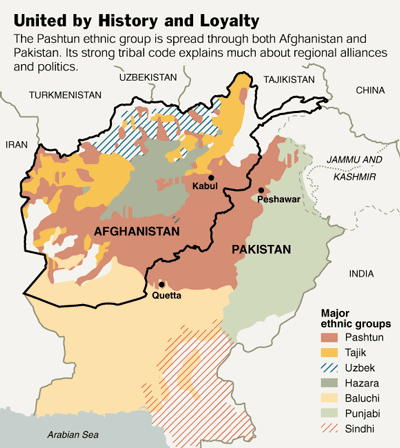
This scenario has not played out, truthfully, in Afghanistan and there is no reason to think that Pakistani tribal leaders won't do the same: take US aid and particularly, arms, then turn around and protect Al Qaeda and the Taliban. They are more Pashtun than Pakistani (or Afghani), and so are the Taliban and much of Al Qaeda in that region.

So you tell me: is blood thicker than a falling dollar?

Saturday, November 10, 2007

The Mystery Of The Sub-Continent


We're all fairly aware of the troubles in Pakistan: suspension of civil rights, a madman desperately holding onto power by playing the terror card, a woman poised to reclaimer family's rule, a nation deeply torn by radical political views....yes, I'm still talking about Pakistan...so as I pondered these things this week, I wondered about something.

Pakistan and India have long had enmity and conflict with each other. At one point, in 1998, they each showed the other its dick by testing nuclear weapons and missile systems.

So why has India kept so quiet over a turmoil in its neighbor's house? There seems to be an answer and it's the horns of the dilemma India finds itself on:
Delhi has a very high stake in the political and security situation in Pakistan stabilising as soon as possible. The future of a tentative peace process that has been under way for nearly four years depends on this.

But increasingly, it is alarmed at the intensity of the confrontation between the Pakistani military and militants in the volatile tribal areas.

Historically some of the militant groups in Pakistan have had links with militants fighting Indian forces in Indian-administered Kashmir.

In the past few years the level of violence in Kashmir has come down and India is keen to keep a lid on it.


India fears a worsening of the situation in disputed Kashmir

But there's a growing perception here that the militants are gaining some ground in Pakistan, a situation which has huge potential consequences for India.
So we see this: India has kept to the sidelines because Musharraf has cracked down on the militants, which means Kashmir has been much more peaceful, while on the other hand, it sees the very same militant groups that it is battling in Kashmir positioning themselves to take power (and the Pakistani nukes).

In other words, as it stands down, it simultaneously has had to stay alert.

Another dilemma: by their silence, India has supported Musharraf. Now that Benazir Bhutto is back, there's a conflict: do you back the dictator who's power structure is shaky, or the former president who is not a guarantee of peace in Pakistan, and is not officially backed by the United States, so not even guaranteed a seat at the table?

The US has remained fairly neutral throughout the history of the India-Pakistan conflicts, with a small lean towards India (world's largest democracy, after all, and a great place to outsource jobs to), until September 11, when the US made a strategic decision to hop under the covers with Musharraf. That couldn't have made India happy, although I'm sure it understood the need.

What you may not be aware of, however, is that shortly after that new approach to Pakistan by the US, the conflict in Kashmir intensified, including a bombing in the Indian parliament. By 2002, Musharraf promised hsi crackdown on the Kashmir militants, and by 2003, things had started to settle down.

A very difficult, complicated puzzle is in place, but then, India invented chess. One would imagine they have some experience in these.

Sunday, September 02, 2007

Islamabad News For Musharraf


Developments in Pakistan keep one wondering how much longer Bush will wait to step in:
Pakistan's former Prime Minister Benazir Bhutto says negotiations with the country's leadership have broken down and that she will announce the day she is coming home on 14 September.

Nawaz Sharif, another exiled former PM, has already fixed a date for his return - 10 September - and he will head a procession through Punjab province, the country's political heartland, to his home city of Lahore.
In case you're keeping score, that's three people with legitimate claim to lead Pakistan.

Bhutto and Musharraf had been negotiating, at first secretly then not-so-secretly, over a power sharing scheme. Musharraf is under pressure from the Pakistani judiciary, since the law states clearly that no one can be head of the state and head of the army at the same time.

It didn't help matters much that Musharraf has had run-ins with the Pakistani courts, trying to fire the equivalent of a SCOTUS judge earlier this year.

Too, Bhutto herself is under some heat, as she has corruption charges pending against her, from two separate administrations (no wonder Condi Rice likes her!)

Clearly, Sharif don't like it (sorry), this pending coalition. A Bhutto-Musharraf power sharing scheme would see a coalition of moderate Pakistani (mostly Muslim) created, although not without some major rifts to be patched over among followers.

Sharif was deposed by Musharraf, so a deal between those two factions would be even more unlikely than a Bhutto/Musharraf alliance.

Sharif is no picnic either. Although he was successful in passing a constitutional amendment that essentially put an end to the process that has seen ten prime ministers since 1990 (the president of Pakistan, the position Musharraf holds, could remove the prime minister, the more powerful post, by declaration), he also passed some pretty nasty legislation with regards to the legislative process, in that the parliament could not declare a vote of no confidence and all party members had to vote along party lines.

Kinda negates the whole democratic process, don't you think?

We're not talking about the lesser of three evils, in other words: on the one hand, in Musharraf you have a military leader, a dictator, who's loyalties lie with an army that has been notorious for aiding the Taliban and Al Qaeda. On the other hand, you have a deposed prime minister who has long-standing (and likely true) corruption charges hanging over her head, and on the other other hand, you have a deposed prime minister who's a bit tyrranical in his own right.

All this unfolds against the backdrop of a deadline of November for new elections, and a growing-but-small number of radical Islamists likely following the Hezbollah and Hamas models for gaining entree into the mainstream political process in order to co-opt a moderate Muslim nation (and for a very good explanation of this crisis, I recommend you pick up this month's National Geographic magazine).

This election in Pakistan could be the single most important development in the United States 2008 Presidential election.

Thursday, June 07, 2007

Gaming Another "Ally"

The silence of the Bush administration regarding this recent story is interesting, to say the least:
ISLAMABAD (Reuters) - Pakistan's chief justice wanted President Pervez Musharraf to dissolve the national assembly and let him oversee the election months before he was suspended from office, the head of military intelligence said on Thursday.

The crisis over Chief Justice Iftikhar Chaudhry's suspension three months ago has resulted in the most serious challenge to General Musharraf's authority since he took power in a military coup eight years ago.

Chaudhry's suspension has sparked a countrywide campaign by lawyers and opposition parties for restoration of full democracy.

The timing is bad for Musharraf, as he has controversial plans to be re-elected by the sitting national and provincial assemblies later this year.
God bless Reuters, because in four grafs, they explain the entire story in a nutshell, so I don't have to.

But I will, because I pay myself by the word. Think about this: Musharraf wants to be re-"selected" by the Pakistani people, who elect the assemblies directly, and those bodies then select the President. The Chief Justice for Pakistan mentions he would prefer, for the people's sake, presumably, to oversee the election directly.

Chaudhry, according to statements by Major-General Mian Nadeem Ijaz Ahmad, Director-General of Military Intelligence, had been cozying up to the Pakistani intelligence and security communities...you know, the same guys who helped fund Al Qaeda attacks on the Pentagon and World Trade Center?...in an effort to pressure Musharraf (and perhaps save his own hide).

Six of one, half a dozen of the other, if you think about it: neither Musharraf nor Chaudhry would have American interests completely at heart unless it was more expedient to their own political future to do so.

Interestingly, Chaudhry may end up winning by default:
ISLAMABAD (Reuters) - Pakistan's President Pervez Musharraf has berated his coalition for leaving him isolated in a crisis that threatens to destabilize a country on the front line of a global anti-terrorism campaign, a newspaper reported.

Musharraf, who is also army chief, is facing the biggest challenge to his authority since he took power in 1999, over a crisis he precipitated by suspending Chief Justice Iftikhar Chaudhry on March 9.

But his government backed off new powers to shut down broadcasters following widespread criticism of media curbs introduced since protests erupted over Chaudhry's suspension on misconduct accusations.

[...]"I bluntly say you always leave me alone in times of trial and tribulation," the paper, citing unidentified participants at the Wednesday meeting, quoted Musharraf as saying.

"I see the party nowhere. You people are not mobilized," he was quoted as telling ruling Pakistan Muslim League members.
Desperate times call for desperate measures, I guess. It seems astounding to me that, given the power this man yields, that his best bullying tactic is...whining?

Contrast that with the Bush administration, practitioners of the art of ruthless politics: "you're either with us, or with them" is not just a mantra for the Global "War" On Terror, you see, and it would be foolish to think otherwise.

In fact, one reason cited for the stunning Democratic victory in 2006 was the dilemma faced by moderate Republicans who were coerced into backing in lockstep the GOP agenda. You can't run from a vote, and as John Kerry's campaign proved, you can't even run from the "right" vote. Karl Rove's biggest blunder in this administration was not having the political savvy to realize that hegemonies of any stripe never last very long, and that his client would have been better served had he allowed even a modicum of dissent on issues that really didn't matter to the true base, like Terri Schiavo, like abortion, like gay marriage.

Like the Iraq invasion.

And yet, with his popularity in the toilet and the country literally turning its back on him and the page on his administration, Bush isn't whining.

Much.

He's certainly not whining about the Republican party, despite the fact that they are defecting (including their voting base) in droves now, and choosing their next poison for 2008.

Perhaps that's a benefit of a democracy just starting to decline, as opposed to a democracy in shadows already. Knowing we have at least the sham of free elections ahead of us next year, it likely makes office holders on their way out resigned to the facts on the ground, rather than making them more desperate to tighten their grip on power.

I was watching the Stanley Cup finals last night...good on you, Ducks...and as the game wound down, Mike Emrick started to talk about the feelings of players on both sides, and how do you get yourself up to playing out the last several minutes of the biggest game of your season, if not your life, knowing you've already lost?

I guess you try to find something you can build on next season, or salvage some dignity, if there is no next season for you.

Bush is trying to salvage some dignity, which is kind of like watching a small puppy try to drag a car with its teeth. His desperate attempts to form coalitions with Democrats to enact mealymouthed legislation so that his entire legacy isn't "Iraq, Iraq, and Iraq" is cute.

Musharraf is trying to find some moral victory, even if the game doesn't appear to be lost. He gambled on the US despite a large Islamic population, assisted us without assisting us, and pissed both sides off.

And that's just sad for him.

Monday, March 26, 2007

Tits On A Bull

There have been some overtures made in Iraq to form a general coalition against a certain terror network:
BAGHDAD (Reuters) - U.S. and Iraqi officials are in contact with representatives of some Sunni Arab insurgent groups to build an alliance against al Qaeda in Iraq, the outgoing U.S. ambassador said on Monday.

Zalmay Khalilzad also said he was cautiously optimistic that "success is possible" in Iraq, but urged leaders to act fast if they were to maintain the support of the impatient U.S. people amid growing pressure for a timetable to withdraw troops.

At his final news conference in Baghdad, he confirmed reports that U.S. embassy and military staff as well as Iraqi government officials had met representatives of insurgent-linked groups on several occasions.
Now, I'm all for jaw, jaw, jaw as opposed to war, war, war, as Churchill would have it, but the aim of those talks is ludicrous: Al Qaeda, although it would exploit the opportunity if presented, has no interest in doing anything in Iraq except foment trouble. This isn't about nation-building for them, ironically.

You see, they already have one: Talibanistan
The residents of Dara Adam Khel, a gunsmiths' village 30 miles south of Peshawar, Pakistan, awoke one morning last month to find their streets littered with pamphlets demanding that they observe Islamic law. Women were instructed to wear all-enveloping burqas and men to grow their beards. Music and television were banned. Then the jihadists really got serious. These days, dawn is often accompanied by the wailing of women as another beheaded corpse is found by the side of the road, a note pinned to the chest claiming that the victim was a spy for either the Americans or the Pakistani government. Beheadings are recorded and sold on DVD in the area's bazaars. "It's the knife that terrifies me," says Hafizullah, 40, a local arms smith. "Before they kill you, they sharpen the knife in front of you. They are worse than butchers."

Stories like these are being repeated across the tribal region of Pakistan, a rugged no-man's-land that forms the country's border with Afghanistan--and that is rapidly becoming home base for a new generation of potential terrorists. Fueled by zealotry and hardened by war, young religious extremists have overrun scores of towns and villages in the border areas, with the intention of imposing their strict interpretation of Islam on a population unable to fight back. Like the Taliban in the late 1990s in Afghanistan, the jihadists are believed to be providing leaders of al-Qaeda with the protection they need to regroup and train new operatives. U.S. intelligence officials think that Osama bin Laden and his deputy, Ayman al-Zawahiri, may have found refuge in these environs. And though 49,000 U.S. and NATO troops are stationed just across the border in Afghanistan, they aren't authorized to operate on the Pakistani side. Remote, tribal and deeply conservative, the border region is less a part of either country than a world unto itself, a lawless frontier so beyond the control of the West and its allies that it has earned a name of its own: Talibanistan.
This is why I've long felt that the US has played footsie with the wrong dictatorship in South Asia...I'd rather they didn't play footsie with ANY dictatorship, but situational ethics comes into play here.

The Time article goes on to talk about how Dick Cheney gave President Musharraf a stern talking to (although no wrist slap, you'll notice) about this territory and it's strategic significance to the "war on terror". It also points out that Musahrraf's hands are tied by the political minefield that is domestic Pakistani governance: he already has large factions very angry at him for siding with the US and his reliance on more moderate groups is slipping as he tightens his fist around Pakistan (all but disbanding the judiciary of the country). All he can really rely on is the Pakistani army, who support the Taliban (and by extension, Al Qaeda).

What's a dictator to do? I'll have more to say on this topic when I make my HUGEST ANNOUNCEMENT EVER in a few days.

Told you it would be huge. But I digress.

To create a coalition against Al Qaeda In Iraq at this point smacks of make-work, the kind of thing you do when you really need a vacation from yourself, but can't be seen away from your desk. You know, like filing.

It might provide an opening for a unifying conference for Sunni, Shi'a and Kurd factions to begin to form a nation, but in my recollection throughout history, those kind of collaborative governments rarely work without an overarching external threat (like, say, England during our revolution). Some loose confederations remain intact, like Indonesia, but there's a different kettle of fish involved: boundaries are fairly well-defined and more important, separate.

Still, I suppose we should be thankful they can find any common ground with the insurgency. Al Qaeda In Iraq was never particularly popular with the citizen-soldiers of the Iraqi insurgency, Sunni division, although there's much to be said of the "enemy of my enemy." Perhaps this will dissuade the Sunni insurgency in toto.

Then again, monkeys may fly out of my butt...


Tuesday, February 27, 2007

The Problem With Crowing About Something...

...is sometimes, you have to eat yourself:
RIYADH (Reuters) - The death toll in a militant attack on French tourists in Saudi Arabia rose to four on Tuesday after a French teenager died from bullet wounds, a hospital doctor said on Tuesday.

The boy's father was among three French expatriates working in Saudi Arabia, the world's biggest oil exporter, who were shot dead during a desert trip on Monday in what appeared to be the first attack by suspected al Qaeda militants on foreigners in three years.

An acquaintance who did not want to be named said the men were machine gunned down in front of the women and children, confirming a report from a security source[...]

They were part of a group of nine French nationals living in Riyadh who had been visiting historic sites and camping in the desert in the scenic western region of the vast desert country.

Islamic militants swearing allegiance to al Qaeda launched a violent campaign to topple the U.S.-allied Saudi monarchy in 2003, with suicide bomb attacks on foreigners and government installations, including the oil industry.
So, Al Qaeda pops its ugly head up in Saudi Arabia after all these drinks. Where else?
KABUL (Reuters) - A Taliban suicide bomber killed up to 12 people at the main U.S. military base in Afghanistan on Tuesday in an attack the rebels said was aimed at Dick Cheney, but the visiting U.S. vice president was not hurt.

An American and South Korea soldier were killed, as well as a U.S. government contractor whose nationality was unknown, NATO and Korean officials said. NATO said 27 people were wounded.

A Reuters photographer at the scene at Bagram Airbase, 60 km (40 miles) north of Kabul, saw eight bodies in addition to NATO's tally of four dead, putting the toll at 12.
Oops! OK, not Al Qaeda, but an incredible facsimile! These were the guys we were supposed to be getting six years ago, right?

Eh....not so much...
ISLAMABAD, Feb 27 (Reuters) - Britain does not foresee any chance of dialogue with Taliban leaders running an insurgency in Afghanistan, Foreign Secretary Margaret Beckett said in Pakistan on Tuesday.

Beckett said she had no inclination to talk to Taliban commanders whose expressed goals were to kill British troops stationed in Afghanistan.

But, she added that talks with former Taliban or sympathisers who were no longer active might be a possibility in the future.
Because, you know, there's been this "spring offensive" in the works since November...
Six years after the declaration of victory in Afghanistan the British government announced the dispatch of 1,400 extra troops yesterday in readiness for an escalation of the violence sweeping the country.

The sending of the troops, along with aircraft, armoured vehicles and artillery, will raise the total force there to 7,700 making it bigger than the one now deployed in Iraq.
...which, if you only watched US network news, you would only have heard about either this weekend, when Dick Cheney finally raised his helmeted head out of his playpen secure bunker to announce with grave alarm:
US Vice President Dick Cheney today sought Pakistan’s help in countering al-Qaida’s efforts to regroup in its remote border region.

He warned that Taliban militants are planning a “spring offensive” in neighbouring Afghanistan, the Pakistani president’s office said.
Now, if you really wanted to flush out the Taliban AND Al Qaeda, wouldn't you go to where the money came from?

No, not Saudi Arabia: Pakistan:
experts say that Pakistan’s military and Interservices Intelligence (ISI) both include personnel who sympathize with—or even assist—Islamist militants. ISI has provided covert but well-documented support to terrorist groups active in Kashmir, including the al-Qaeda affiliate Jaish-e-Mohammed, which investigators linked to the December 2001 attack on the Indian parliament and the February 2002 murder of Wall Street Journal reporter Daniel Pearl.
*Ahem* But we've made our bed and now must sleep in it. I swear, Musharraf has done such a bang up job of misleading the Bush administration, I'm surprised he hasn't tried to sell them on the idea of a pipeline through his country to the India! For natural gas!

Um. Oops.

So we have terror attacks against Westerners in Saudi Arabia resuming, a Taliban offensive in Afghanistan, assisted by Pakistan's ISI, forming up, and possible Al Qaeda cyberattacks on our banking and other financial institutions.

In effect, they've taken six years to regroup, reform and re-energize the network. Add to that the growing threat of non-Al Qaeda terrorism, and the fact that every year since we've attacked Iraq has seen more deaths from more terrorist attacks in more countries than the previous year.

All while Al Qaeda lay dormant. While some of our *koffkoff* finest minds have said Al Qaeda is on the run...

And Bush thought 2006 was a bad year for him! I expect he'll be crying for his mommy by September.

, ,