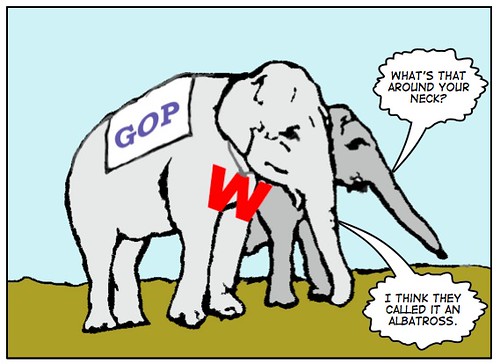
If you're old enough to remember the Carter administration (1977-1981), then you'll remember the ugly phenomenon, unprecedented in a free-market economy, of stagflation.
Loosely defined, stagflation is when the economy is stagnant (i.e. a recession, in which economic activity slows) coupled with hyperinflation (when prices skyrocket through the roof).
The Carter stagflation hit when OPEC decided to play games with the price of oil. Since America was far and away the single largest consumer of OPEC oil, this was targeted directly at us, likely as a result of several foreign policy factors (Iran being number one among them).
Now that oil is flirting with its all-time record highs, as adjusted for inflation, as improbable as it may seem, we look likely headed down the stagflation path once again.
It's hard to describe what living in those times was like. The prime rate was up around 20%, while inflation ran at a then-unheard of (in America) rate of 15% (some studies indicate inflation may actually have reached higher levels in the past, like during the Civil War, but there's no clear measure of these incidents).
So the government was borrowing money at credit card rates, while families were seeing their incomes deteriorate at about one and a half percent a month, meaning if you made $30,000 a year, which was a really comfortable salary in 1979, by the end of that year, effectively you were making $25,000, but still paying taxes at the $30,000 rate, I should add. Further, banks stopped lending money at points in the incident, because if prime lending rates were 15%, say, but inflation was 16%, they were actually losing money in the deal.
Let's look at the current situation, tho: the housing market has cooled off and begun to drop nationwide. Housing prices have traditionally been the source of "wealth" in America, a fairly nebulous term that really means, "in a pinch, can I sell my home for more than I paid and pay down my credit cards?"
So long as the answer was "yes," people felt secure and kept on buying. Now the answer is "Eh. Not so much!"
This morning, we've seen clear signs that the economy is in serious trouble. While the Producer Price Index, the average cost to produce a good and bring it to market, shot up 3.2% on an annual basis in November, retail sales were up only 1.2%.
Which means that the entire increase in retail sales can be attributed ONLY to inflation (and the PPI doesn't include direct energy costs!), meaning the consumer economy dropped by about 2% in November. People bought 2% less in November. Period.
The consumer markets make up about 70% of the gross domestic product (the entire economic activity of a nation), so we'll call this a drop of about 1.75% in the economy.
In other words, a recession. A contraction. Not a good thing.
In current economic theory, you fight inflation by raising interest rates. This tightens available credit, forcing companies to put off infrastructure investment, and also means people like you and me pay more interest on our credit cards.
But the Fed has had to lower interest rates in response to the crippling sub-prime mortgage crisis, which has rippled now into prime mortgages. Anyone who believed this crisis was contained in the sub-prime markets is an idiot, including Ben Bernanke.
No rational borrower in his right mind is going to see Ditech.com offering 0% adjustable rate mortgages and not bite their banker's ass about paying 5%, even on a fixed rate loan! Hell, I bitched about paying 1.9%!
This clearly ripples through the credit markets, and is a far larger problem than we've been led to believe.
And don't think this is only an American problem. England's Northern Rock bank debacle shows that it's at least hitting the EU, and many central bank heads believe that we might see the first global stagflation in history.
You wanted to be a war president, Herr Bush? You will be, in 2008. A global stagflation will mean more poverty, more starvation, more angry young men and women in the streets of poor countries with weak tyrannical leaders.
The pieces are in place, ladies and gentlemen, for a true World War III. And we have only ourselves and our greedy overlords to thank.



 Posts
Posts


